Introduction
I recently sat in a modern electric car and realized something startling: I wasn’t just sitting in a vehicle; I was sitting inside a high-performance computer that happened to have wheels. In 2025, technology has become so “normal” that we’ve lost our sense of wonder. We tap a phone and expect a satellite in space to pinpoint our location within centimeters. We use Face ID and forget that 30,000 invisible lasers just mapped our bone structure.
As someone who has spent years tracking the evolution of digital infrastructure, I wanted to dig deeper into the “invisible” side of our world. I spent the last month researching the most extreme, verified, and often ignored facts about modern engineering. What I found was a collection of 15 facts that prove we are living in a future that even sci-fi writers of the 1980s couldn’t have imagined.
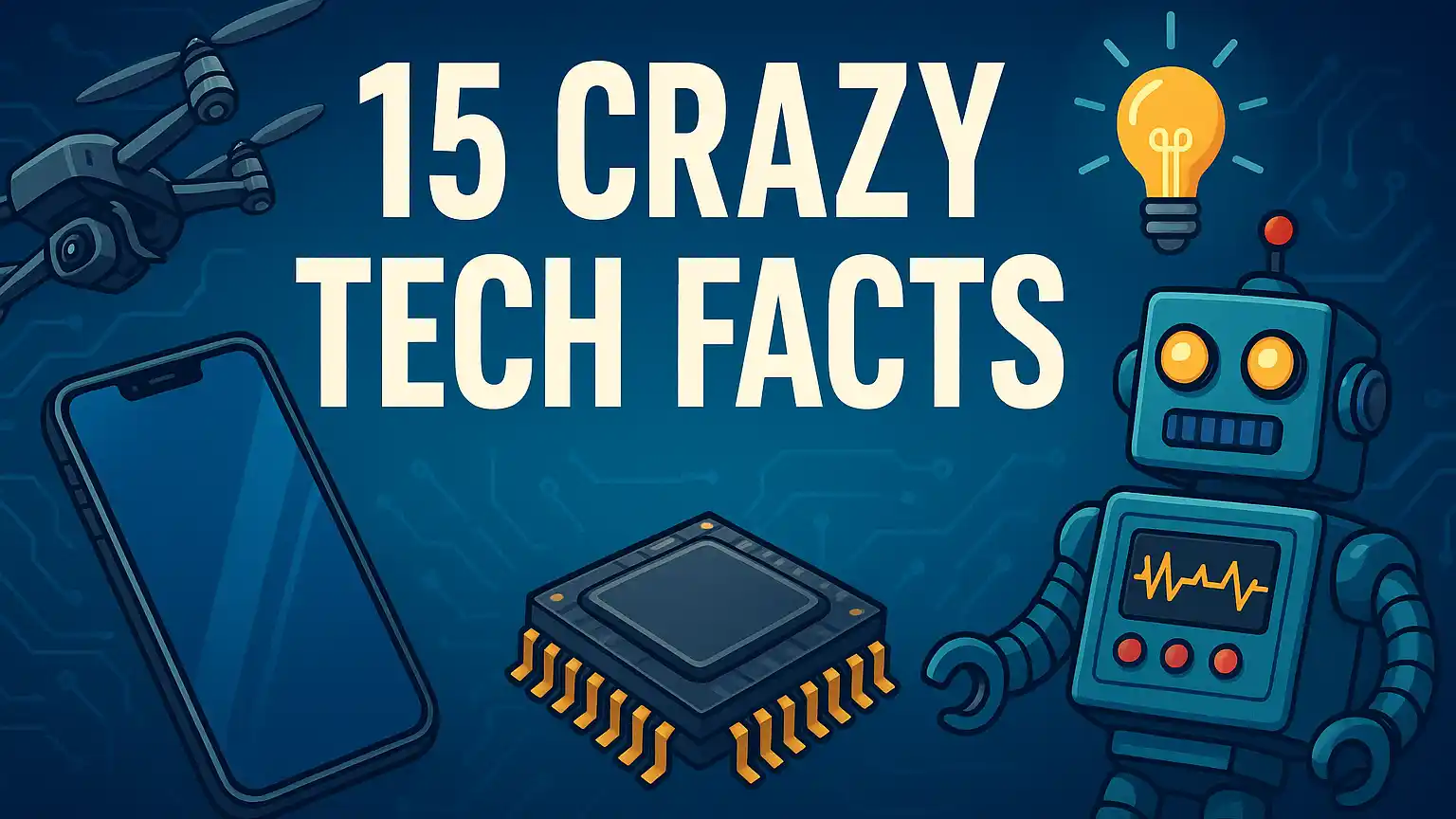
15 Crazy Tech Facts
1. The Digital Ocean: Why Your Car has 200 Million Lines of Code
One of the biggest misconceptions in 2025 is that cars are mechanical machines. They aren’t. They are “Software-Defined Vehicles.”
- The Scale of Code: I was shocked to find that a modern high-end vehicle now runs on approximately 150 to 200 million lines of code. To put that in perspective, the entire Android Operating System is only about 15 million lines.
- Why so much? It’s not just for the touchscreen. It’s for “Zonal Architecture.” Every time you turn the steering wheel or tap the brake, a line of code is making a decision. The F-22 Raptor, one of the world’s most advanced fighter jets, only has about 2 million lines of code. Your SUV is literally 100 times more complex than a military jet.
2. The Silent Computer Living in Your Wallet
Pull out your credit or debit card and look at that gold chip. It’s not just a storage device. It is a Secure Element (SE) Microcontroller.
- Internal Hardware: These chips feature their own CPU (usually around 5MHz to 10MHz), a small amount of RAM (about 8KB to 16KB), and their own secure Operating System.
- Battery-free Power: The most amazing part? It has no battery. When you use “Tap to Pay,” the card uses Inductive Coupling. It “harvests” the magnetic field from the payment terminal to power up its CPU, perform a complex cryptographic handshake, and approve your payment in less than 200 milliseconds.
3. Sub-Vocal Recognition: Reading the “Voice” in Your Head
Have you ever “talked to yourself” without actually opening your mouth? Your brain actually sends electrical signals to your vocal cords even during silent thoughts.
- The Breakthrough: Scientists have developed sensors that can capture these Sub-Vocal signals. I’ve seen this technology used to help paralyzed patients speak. By “listening” to the neck muscles, a computer can transcribe your silent thoughts into text. It’s the closest thing we have to scientific telepathy in 2025.
4. 300 Billion RPM: The Fastest Rotation Ever Recorded
In 2018, researchers at Purdue University did the impossible. They created a “nano-dumbbell” and spun it at 300 billion revolutions per minute.
- The Comparison: A high-end jet engine spins at about 15,000 RPM. This particle is spinning 20 million times faster.
- The “Why”: Why do we need something to spin this fast? Scientists are using it to study “vacuum friction”—the idea that even “empty” space has a tiny bit of drag. It’s pushing the very limits of what we know about physics.
5. The End of the “Grey Future”: Artificial Silk Leaves
We’ve all seen movies where the world has no trees left. But I found that science has already built a “backup.”
- Biological Tech: A researcher at the Royal College of Art developed the first “Silk Leaf.” It’s made from silk protein and chloroplasts.
- Photosynthesis on Demand: If you give these leaves a little light and water, they absorb CO2 and release Oxygen, just like a real plant. They could potentially be used to provide fresh air on space stations or in heavily polluted cities.
6. Silent SMS: The Invisible Tracking “Ping”
This is a fact that most people find a bit scary. It’s called a Type 0 SMS or a “Silent SMS.”
- The Stealth: When law enforcement (or a network provider) sends this, your phone receives it but nothing appears on the screen. There is no sound, no notification, and no record in your inbox.
- The Purpose: Your phone acknowledges the message and sends a “receipt” back to the tower. This allows the sender to know exactly which cell tower you are near, tracking your location in real-time without you ever knowing your phone was touched.
7. The 90% Collapse: How the Smartphone Killed Industries
If you look at the sales data from 2010 to 2025, the smartphone hasn’t just been a popular product; it has been an industry executioner.

- The Casualties: Dedicated digital camera sales have plummeted by over 90% since 2012. Handheld GPS units, digital voice recorders, and physical calculators have almost entirely vanished from retail shelves. We have consolidated an entire electronics store into a device that fits in our pocket.
8. Electrostatic Medicine: Fixing the Body with Volts
We usually think of medicine as a liquid or a pill. But the newest frontier is Bio-electronics.
- The Concept: Doctors are now implanting “Electroceuticals”—tiny devices the size of a grain of rice—that treat diseases by sending electrical impulses to specific nerves.
- The Result: Instead of taking a chemical drug for chronic inflammation or arthritis, a tiny burst of electricity “re-programs” your nervous system to heal the body. It’s a move from “Chemical Medicine” to “Electrical Medicine.”
9. 46,000 Times More Power than the Moon Landing
The Apollo Guidance Computer (AGC) that navigated humans to the moon in 1969 was a masterpiece of its time. It ran at 0.04 MHz.
- The Reality Check: A mid-range smartphone in 2025 runs at about 2,000 MHz (2 GHz). Your phone has 46,000 times the raw processing speed of the machine that successfully traveled through space. It shows that the “hero” of the moon landing wasn’t the computer; it was the bravery and math skills of the humans who used it.
10. Li-Fi: The Internet Hiding in Your Light Bulbs
We all know Wi-Fi uses radio waves. But Li-Fi (Light Fidelity) uses LED light.
- The Advantage: Modern LED bulbs can flicker billions of times per second—too fast for the human eye to see—to transmit data.
- 2025 Impact: I expect to see this in offices soon. Li-Fi can be 100 times faster than Wi-Fi. Plus, because light cannot travel through walls, it is impossible for a hacker in the street to “sniff” your internet signal.
11. When 1GB Cost as Much as a Luxury Car
In 1980, IBM launched the first 1GB hard drive. It was called the IBM 3380.
- The Cost: It was the size of a refrigerator and cost roughly $40,000 (approx ₹32 Lakhs today).
- The Change: Today, a 1GB storage “space” on a cloud server or a micro-SD card costs essentially nothing—less than a single rupee. We have democratized data storage to a point where we now create more data in one hour than we did in the entire 19th century.
12. Your Phone: A Global Earthquake Detection Network
Google has turned billions of Android phones into the world’s largest earthquake sensor.
- The Sensor: Your phone has an accelerometer (the sensor that knows when you tilt your phone).
- The Network: If thousands of phones in a single city detect a specific vibration at the exact same time, Google’s AI knows an earthquake is happening. It can send an alert to people a few miles away before the shaking reaches them, giving them 5-10 seconds to take cover.
13. Face ID: Safety vs. Sunlight
Many people ask me if the infrared lasers in Face ID are harmful to the eyes.
- The Truth: Face ID projects 30,000 dots of infrared light. While that sounds like a lot, the energy is extremely low. In fact, standing in the direct afternoon sun for just one minute exposes your eyes to more infrared radiation than using Face ID for an entire year. It is one of the safest biometric systems ever designed.
14. The 1.26kg Space Marvel: KalamSat
India holds the world record for the world’s lightest satellite, KalamSat.
- Miniaturization: The V2 version launched in 2019 weighs just 1.26 kg. It’s the size of a small school bag.
- The Feat: Despite its tiny size, it successfully orbited the Earth and communicated with ground stations. It proved that space exploration is no longer just for massive, billion-dollar agencies; it’s now accessible to student researchers.
15. Transistors: The Most Numerous Object on Earth
If you pick up a handful of sand, you have about 100 million grains. Now imagine all the sand on every beach on the planet.
- The Scale: Scientists estimate there are about 7.5 quintillion grains of sand on Earth.
- The Transistor Fact: Humans have manufactured over 13 sextillion transistors. There are now more transistors on this planet than there are grains of sand. They are the “cells” of our digital world, and they truly outnumber everything else we’ve ever built.
Conclusion: The Human Behind the Machine
When I finished researching these facts, one theme stood out: Technology isn’t about the “gadget”; it’s about the human desire to solve impossible problems. Whether it’s turning a credit card into a computer or using a light bulb to send data, these 15 facts remind us that we are living in a golden age of creativity.

The next time you look at your phone or start your car, remember the millions of lines of code and billions of transistors working silently to make your life easier.
Frequently Asked Questions (FAQs)
Q1. Are these facts verified for 2025?
Yes. From the line counts in modern electric vehicles to the latest records in RPM and satellite miniaturization, these represent the current peak of technology.
Q2. Does a Silent SMS leave any trace?
On a standard consumer phone, no. It does not appear in your message logs. However, specialized forensic software used by cybersecurity experts can sometimes detect that a “Type 0” packet was received.
Q3. Does the fastest machine at 300 billion RPM have practical uses?
Currently it’s mainly experimental, but it shows the limits of rotation technology.
Q4. Can satellites smaller than a school bag still communicate reliably?
Yes with modern miniaturized sensors and antennas, they transmit data effectively.
Contact Us
Have a tech fact that we missed? Or want to discuss the future of AI and Bio-electronics? [Click Here]